The Ferndale Fortitude (Vol. I No. 4, September 27, 2021)
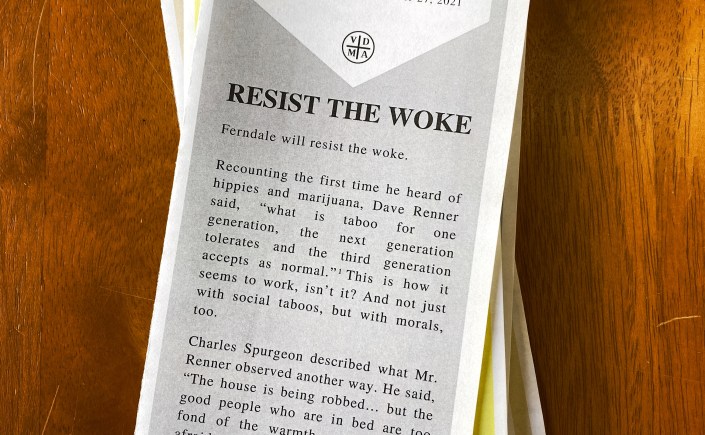
Ferndale will resist the woke.
Recounting the first time he heard of hippies and marijuana, Dave Renner said, “what is taboo for one generation, the next generation tolerates and the third generation accepts as normal.” (71 Reunion Committee & Our Story Staff, “Riders on The Storm,” Our Story: The Ferndale Museum, 42 no. 3 [May-June 2021]: 7.) This is how it seems to work, isn’t it? And not just with social taboos, but with morals, too.
Charles Spurgeon described what Mr. Renner observed another way. He said, “The house is being robbed… but the good people who are in bed are too fond of the warmth, and too much afraid of getting broken heads, to go downstairs and meet the burglars….” (Owen Strachan, Christianity and Wokeness [Washington D.C.: Salem Books, 2021], 205.)
Spurgeon’s words present toleration and the acceptance of sin in terms of contented selfishness and cowardice.
The words attributed to Edmund Burke address moral creep in yet another way. “The only thing necessary for the triumph of evil is for good men to do nothing.” Amen! And Ferndale has them. Good men. That’s why I’m confident we will resist the wokeness that has infected our country. We have too many good men to tolerate and accept Marxism as the norm. I can already hear them getting out of bed, heading downstairs, and meeting the woke burglars where they stand.
The only thing necessary for the triumph of evil is for good men to do nothing.
Like Communism, wokeness derives from the ideas of Karl Marx. It’s “an activist social religion [that] specializes in mobilization. It creates a false society-wide sin pattern, raises the alarm to solve it, marshals support from the public square, and then agitates for sweeping social and cultural change to combat it,” (Strachan, Christianity and Wokeness, 203). You might say that the woke rally cry urges Ferndalers to be indivisible in a way that marches to that ol’ Marxian maxim, workers of the world, unite! (Karl Marx and Friedrich Engels, The Communist Manifesto, Gutenberg, January 25, 2005. https://www.gutenberg.org/cache/epub/61/pg61.html)
But as I said, good men are already out of bed. They can hear the woke doublespeak. They have recognized that wokeness is not about unity, equality, or justice. They see that it is divisive and that it encourages neighbors to despise one another. They recognize that it promotes a pride that condemns people who have different thoughts and how it robs us all of joy and peace. They see that it directs us away from the Gospel of Jesus Christ, makes us bitter, traps us in error, makes it difficult for forgiveness and mercy to prevail in our hearts, and distracts us from God’s presence. (Strachan, Christianity and Wokeness, 201-202.)
Good people in Ferndale have begun to see the truth and many of them are already in action. They are countering wokeness by returning to the values upon which Ferndale was built.
If you are not afraid to confront the burglars, then Owen Strachon offers advice on how to combat wokeness.
Be a happy member of a local church. The local church is where we see that the Gospel saves people of every background, sin pattern, and skin color. It is the place of true unity, equality, and justice.
Be salt and light. Anywhere you see it, fight injustice. Anywhere you can, spread the hope of Christ to your neighbors.
If needed, make the hard decision to leave a compromised church. Respectfully express your concerns to your pastor and elders, pray for them, and if they do not repent of woke preaching and teaching, find a local church that has not been taken captive by a false gospel.
Protect and help your children. Raise your children in the church. Don’t assume your child is being trained well by others. Take ownership of their education, whether secular or spiritual. Model the Christian faith for them.
Pray daily for the church and the world. Give your greatest effort to preserving and strengthening the church. The Christian faith is a public faith. Live it for all to see.
If you would like further guidance on how to resist wokeness in Ferndale, Owen Strachon’s book, Christianity and Wokeness, is available at Chapman’s Bookery. Or you can connect with me via the contact [page].
The Ferndale Fortitude (Vol. I No. 3, August 3, 2021)
In 1908, well-known writer, G.K. Chesterton, said, “If you leave a thing alone you leave it to a torrent of change. If you leave a white post alone it will soon be a black post.” (G.K. Chesterton, Orthodoxy, Colorado Springs, CO.: WaterBrook Press, 1994. 171.) Ferndalers can perceive this truth with ease. Our butterfat palaces require regular attention if they are to retain their Victorian beauty and charm. Chesterton explains that “If you particularly want [the post] to be white you must be always painting it again; that is you must be always having a revolution… [I]f you want the old white post you must have a new white post.” (emphasis added)
If you leave a thing alone you leave it to a torrent of change. If you leave a white post alone it will soon be a black post.
G.K. Chesterton
Preservation, then, is the art of actively repelling, rebuffing, and refusing the torrent of change that lies in wait to displace what one wants to maintain. It is continually updating the old with the new in a way that replicates and perpetuates the old. If you don’t do this, something new will still take the place of the old. But be warned, it will look entirely different.
In 1975 our city was officially designated a State Historic Landmark by the California State Park Office of Historic Preservation.2 This designation distinguishes our community from others and highlights that our city is, to use Chesterton’s language, engaged in the revolutionary effort of preserving the old. Indeed, it is a joyful and unified cause that enlists all but a few who choose to take up residents in and around our cherished village.
Obviously, the truth Chesterton articulated reaches beyond fence posts and Victorian homes. It extends beyond the purview of our Design Review Committee, touching not only what falls in the Design Control Zone, but everything susceptible to rot and decay, all of creation, including human beings, physically, as well as spiritually.
Historic, orthodox Christian teaching informs us that God is unchanging, and His Word endures forever, unscathed by the torrent of change that would overtake it (Malachi 3:6; Hebrews 13:8; Isaiah 40:8; Matthew 24:35). From this same unchanging Word, Christians learn of their sin and how to wage an ongoing revolution against it. We live baptismal lives of daily repentance, continually fighting against the evil that threatens to harden our softened hearts (Ezekiel 36:26). To leave our souls alone is to give them over to a depraved torrent of change (Romans 1:28).
Rightly understanding that without constant intervention, everything will rot and decay, even faith in Christ— and with it the culture of goodness, truth, and beauty that Christianity creates and sustains—is why the pioneers who settled our agricultural community brought Christianity with them and established Christian congregations and erected sanctuaries where they could gather regularly to hear God’s Word in their own languages and receive His Sacraments. They knew the alternative was untenable. Had the early settlers of Ferndale left their faith alone because they were too busy establishing their farms and businesses, raising their families, and forming our city, we would have nothing to preserve. Our forefathers knew that when you “seek first the kingdom of God and his righteousness,” life’s other concerns are also resolved (Matthew 6:33), but if you leave the kingdom of God alone, corruption will take its place within you and those around you. As 1 Timothy 4:16 says, “Keep a close watch on yourself and on the teaching. Persist in this, for by so doing you will save both yourself and your hearers.”
Do you know that old white picket fence so often associated with the American dream of life, liberty, and the pursuit of happiness? Well, it needs a fresh coat of paint. In Ferndale, we’ve done a great job preserving our historic buildings, but a torrent of change seeks to displace our culture. To fend off the mold, we must return to where the One beyond change has promised to meet us: in His Church (Matthew 18:20). There, we renew our brushes with the refreshing paint of His Word and Sacraments. There, the old truth is delivered anew. There, we’re equipped with the paint supply needed to protect our heritage from the unwanted rot and decay that seeks to make us and our town into something new and different.
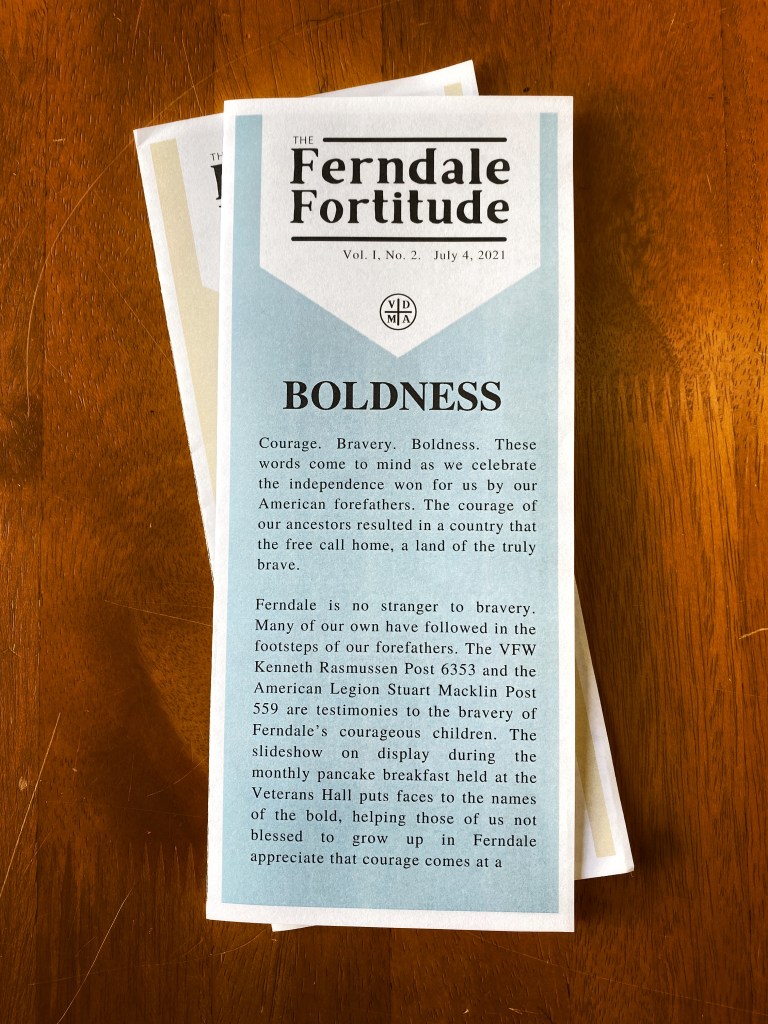
The Ferndale Fortitude (Vol. I No. 2, July 4, 2021)
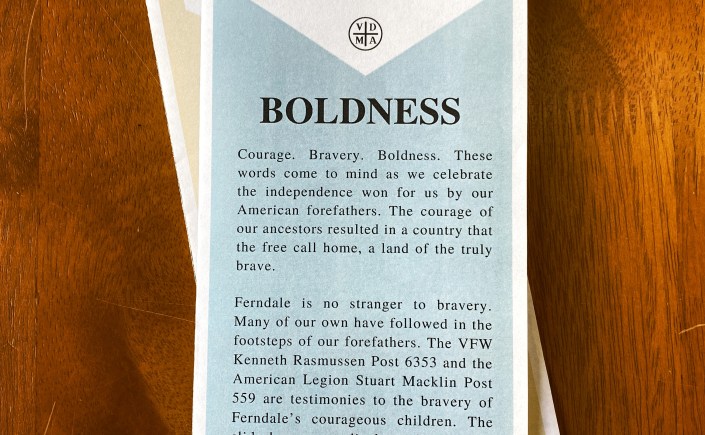
Courage. Bravery. Boldness. These words come to mind as we celebrate the independence won for us by our American forefathers. The courage of our ancestors resulted in a country that the free call home, a land of the truly brave.
Ferndale is no stranger to bravery. Many of our own have followed in the footsteps of our forefathers. The VFW Kenneth Rasmussen Post 6353 and the American Legion Stuart Macklin Post 559 are testimonies to the bravery of Ferndale’s courageous children. The slideshow on display during the monthly pancake breakfast held at the Veterans Hall puts faces to the names of the bold, helping those of us not blessed to grow up in Ferndale appreciate that courage comes at a substantial human cost. Neighbors, friends, and family members have experienced real loss because courage is more than an idea. It is lived. Every one of Ferndale’s soldiers—those who came home and especially those who didn’t—reminds us that there are consequences to standing up for what is good, right, and true.
We are right to think of the Founding Fathers as brave. They put everything on the line so that man could live freely. We are right to think of Ferndale’s vets the same way. They exemplify Cream City’s courage. Likewise, we are right to live accordingly, exercising the same boldness that moved our patriotic predecessors and protectors to service.
Courage, bravery, and boldness convey an image of physical risk. One may think of heroes digging deep to overcome grave danger to life and limb, willing to die in service to others rather than cower to the fear in their hearts.
It is true for America, and it is true for Ferndale, that our fortitude is a fruit of the Christian faith. The steeples that extend above our village stand as constant reminders of the source of our courage. The crosses atop our bell towers teach attentive residents and tourists alike that our town once drew courage from the boldness of Christ who courageously suffered corporal punishment for crimes He didn’t commit to save the lives of others, we who are unworthy of His sacrifice.
Jesus was bold and His Word teaches His followers to be bold. The Greek word for boldness is parresia. Its basic definition reveals that boldness is not an attribute reserved for soldiers on the battlefield, nor was it unique to America’s Founding Fathers. It’s something everyone can live out in his daily life. Parresia (boldness) means to be able to say anything. That is, to be able to speak freely. That is the root of what it means to be bold. Heroic acts start with finding enough courage to verbalize what is true, not just when it’s popular, but even when it’s not (2 Tim. 4:1-5). In Classical Greek, parresia is used for the right to freedom of speech.
Boldly speaking the truth freely, even when it won’t be well-received, is the sprouting seed of bravery, which, when grown, enables a man to lay down his life for what is good, right, and true. We see this in Jesus. He was killed under the influence and unrest of public opinion, but not before He spoke against the false teachings that had corrupted His people. We see this in Ferndale’s fallen soldiers, too. Before our heroes displayed bravery on the battlefield, they spoke up as free men who were willing to preserve the rights of their fellow man because it is a good and true act of service to do so.
As we celebrate our independence, I pray that all of us who call Ferndale home will remember the courage of those who, for the sake of their neighbors, were not only bold enough to die freely but first learned to speak freely. May each of us dig deep and be bold. May we always speak freely against the lies that assault truth, the evil that attacks goodness, and the wrongs that corrupt what is right.
If you would like to learn more about how courage is a fruit of the Christian faith, you can reach me via the contact [page].
The Ferndale Fortitude (Vol. I No. I, June 3, 2021)
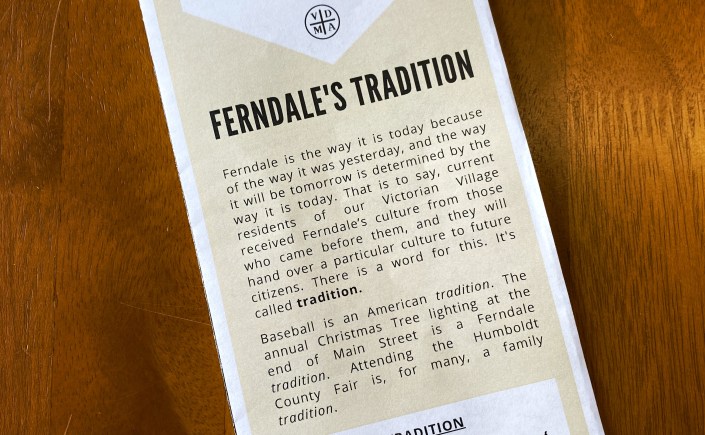
Ferndale is the way it is today because of the way it was yesterday, and the way it will be tomorrow is determined by the way it is today. That is to say, current residents of our Victorian Village received Ferndale’s culture from those who came before them, and they will hand over a particular culture to future citizens. There is a word for this. It’s called tradition.
Baseball is an American tradition. The annual Christmas Tree lighting at the end of Main Street is a Ferndale tradition. Attending the Humboldt County Fair is, for many, a family tradition.
Tradition:
1. an inherited, established, or customary pattern of though, action, or behavior;
2. the handing down of information, beliefs, and customs by word of mouth or by example from one generation to another without written instruction.
Traditions can be good or bad. In my work as the pastor of St. Mark Lutheran Church (795 Berding St.) I am aware of the traditions of the congregation, and I strive to strengthen the good and refute the bad.
The Greek word for tradition is paradidomi and its most literal translation is simply, “to hand over.” The apostle Paul handedover to the church in Corinth as of first importance what he alos received (1 Cor. 11:23).
Christians have been handing over the good news that Jesus Christ is the Savior of the world for millennia. Likewise, ever since Seth Shaw built his cabin and called his home Ferndale, every settler of our community has participated in handing over Ferndale’s tradition.
Clear evidence that our Ferndale forefathers understood their place in the line of cultural tradition can be seen in what the first editor of the Ferndale Enterprise published in May of 1879. William Gaston Jones, co-founder of the newspaper wrote:
We want to live in peace with all, and will if possible. To chronicle fully and faithfully current events; to praise the good and denounce the evil; to advocate educational enterprises and all industries; in short, to oppose everything that will retard the growth and prosperity, and advocate everything that will develop and build up valleys and towns, has been, and shall continue to be our desire and aim.
Ediline, Ferndale… The Village: 1875-1893, 24.
W.G. Jones, along with his brothers James and Archibald, declared just what kind of Ferndale tradition they wanted to hand over to the readers of their newspaper. Communities, families, and individuals hand over ideas, values, behaviors, and customs to those around them.
The question is, what Ferndale tradition will we hand over?
The handing over of Christian teaching was apparent in Jones’ quote above. We don’t need to know that the founders of the Ferndale Enterprise were the sons of the local Methodist minister, Rev. Charles P. Jones (Edeline, Ferndale… The Village: 1875-1893, 23.). Williams words alone, “We want to live in peace with all, and will if possible,” reveal that our first newspaperman received what the apostle Paul wrote in Romans 12:18,
“If possible, so far as it depends on you, live peaceably with all.”
The Christian traditions of peace and personal responsibility that were handed over for some 1800 years, from Paul to William, are easily recognizable to the Christian because they are the same traditions that were handed over from Paul to us, in our village, country, and across the world. Rev. Jones came to Ferndale to hand over the apostolic tradition of the Gospel of Jesus Christ.
This is what pastors do. We teach the Christian traditions to those we live among, not only for them but so that the truth of salvation in Jesus Christ will be handed over to the generations to come. By the grace of God, through the Holy Spirit working among His people, Ferndale received a minister in Rev. Jones, and as an added blessing, through the entrepreneurial spirit of the pastor’s children, our predecessors also received a newspaper.
The Christian upbringing of the Jones brothers was, no doubt, behind their desire for the paper to praise the good and denounce the evil, an enterprise dedicated to building up our town and opposing any efforts that would tear them down. The Jones brothers knew next to nothing about the newspaper industry before they opened the Ferndale Enterprise. They embarked on the adventure anyway. In a similar spirit and in accord with the tradition they aimed to hand over, as cited above, I have published this little pamphlet and by God’s grace I hope to print future volumes of the Ferndale Fortitude.
Ferndale is our home. Safeguarding our local culture is our duty. Will we hand over a culture of peace and personal responsibility where residents praise the good and denounce evil? Do we still know the difference? Will you oppose the disintegration of our historic traditions and the Christian values that inform them and contend for the good of all your neighbors? I truly hope so.
If you’d like to further discuss the connection between our local traditions and the Christian traditions known to our Ferndale forefathers, I can be reached via the contact [page].
Our sermon text tells us both robbers reviled Jesus. Luke’s Gospel goes into more detail. What does one of them eventually do, and what is the outcome?
What has Jesus promised us today?
Eschatological: adjective
a branch of theology concerned with the final events in the history of the world or of humankind
a belief concerning death, the end of the world, or the ultimate destiny of humankind
What two words describe the two robbers?
Which one best represents you?
What other two men do these robbers remind us of (Luke 18)?
How do we become like the one who is with Jesus in Paradise?
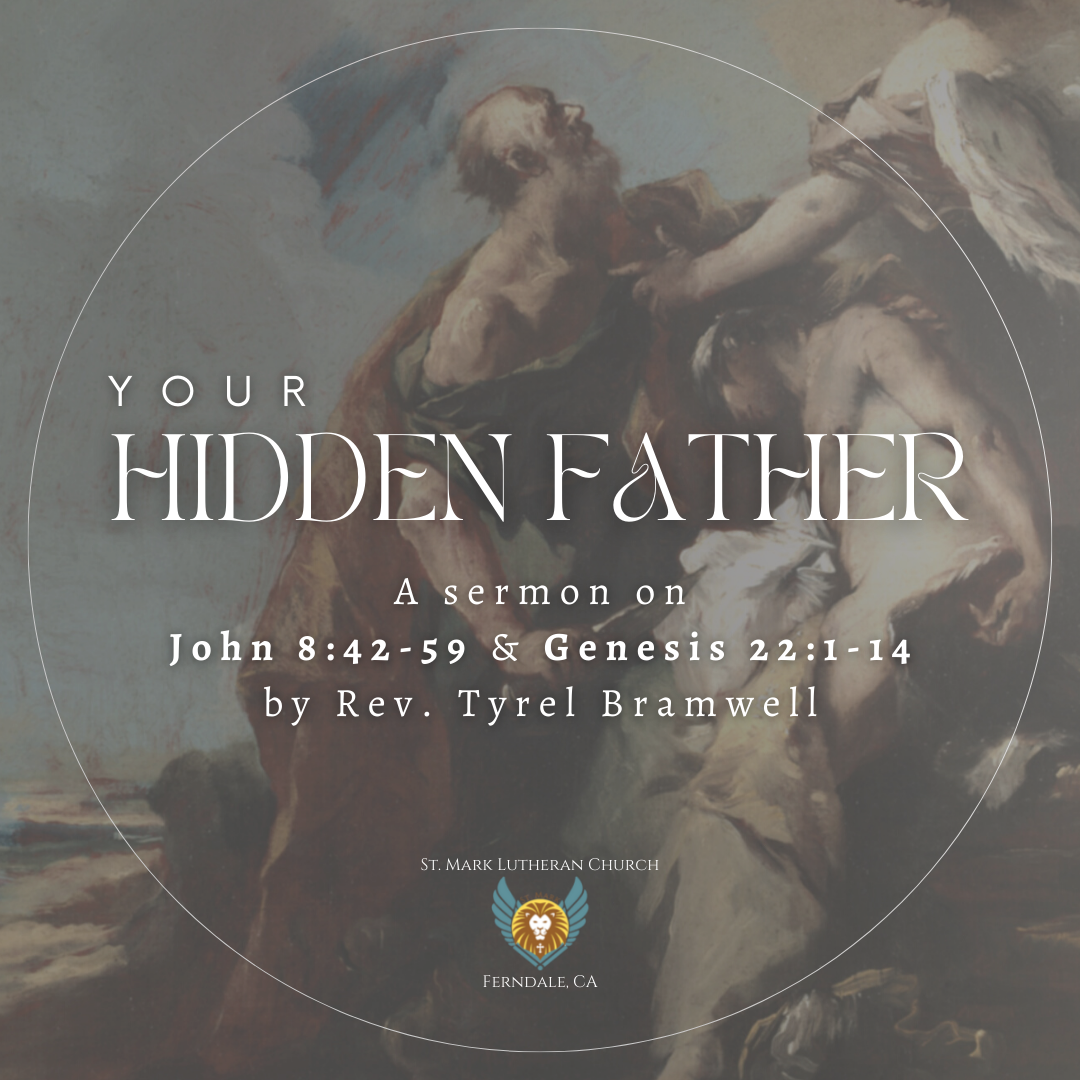
In today’s Gospel reading Jesus and His opponents get into a hard-hitting discussion in which He tells them they’re the devil’s children. Why doesn’t Jesus shy away from saying hard things to His opponents?
Who picked up the stones in John 8:59? What did Jesus do?
God is hiding in the Genesis 22 text. Where is Christ hidden? Where is His Father hidden?










 St. Mark Lutheran Church