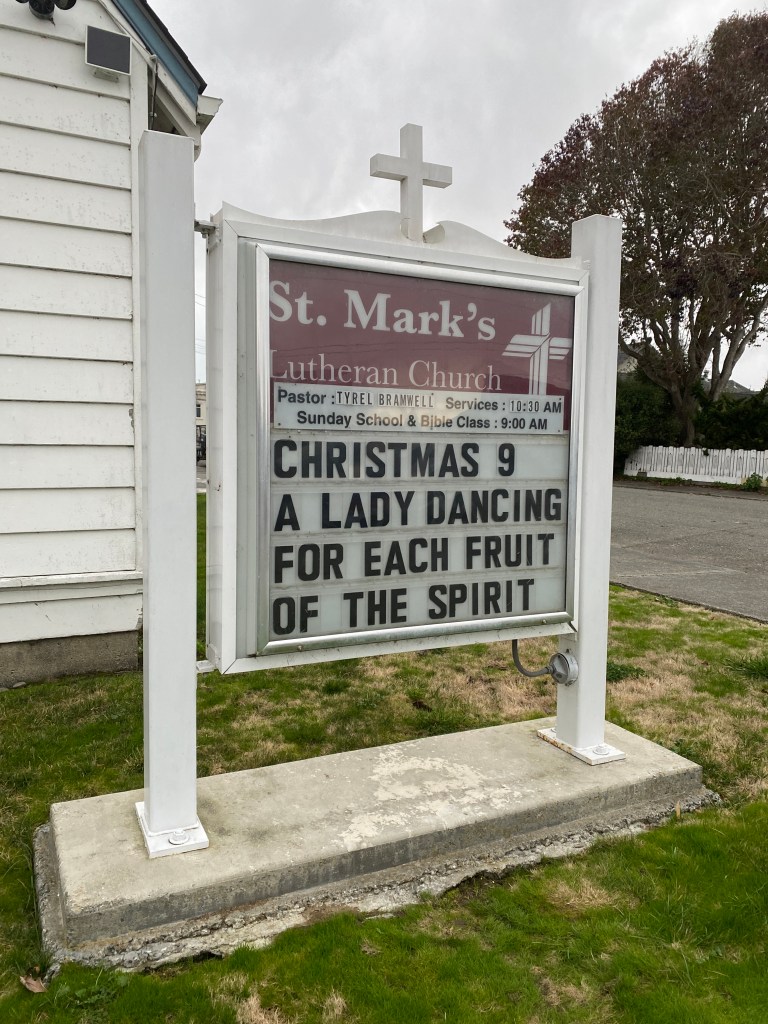
On the ninth day of Christmas, my true love sent to me nine ladies dancing…
“But the fruit of the Spirit is love, joy, peace, patience, kindness, goodness, faithfulness, gentleness, self-control; against such things there is no law.”
It is said that the lyrics of the well-known Christmas carol, “The Twelve Days of Christmas” are symbolic. As the story goes, (I haven’t done much research into the historicity of this tradition) the song was written by Roman Catholics in England during the 18th century when they were being persecuted by the Church of England. The numbers seem to be the most important indicator of the symbolism. Most importantly, for our purposes, is the acknowledgment that Christmas is a season on the Church’s calendar, which lasts twelve days, as is obvious from the song’s title.
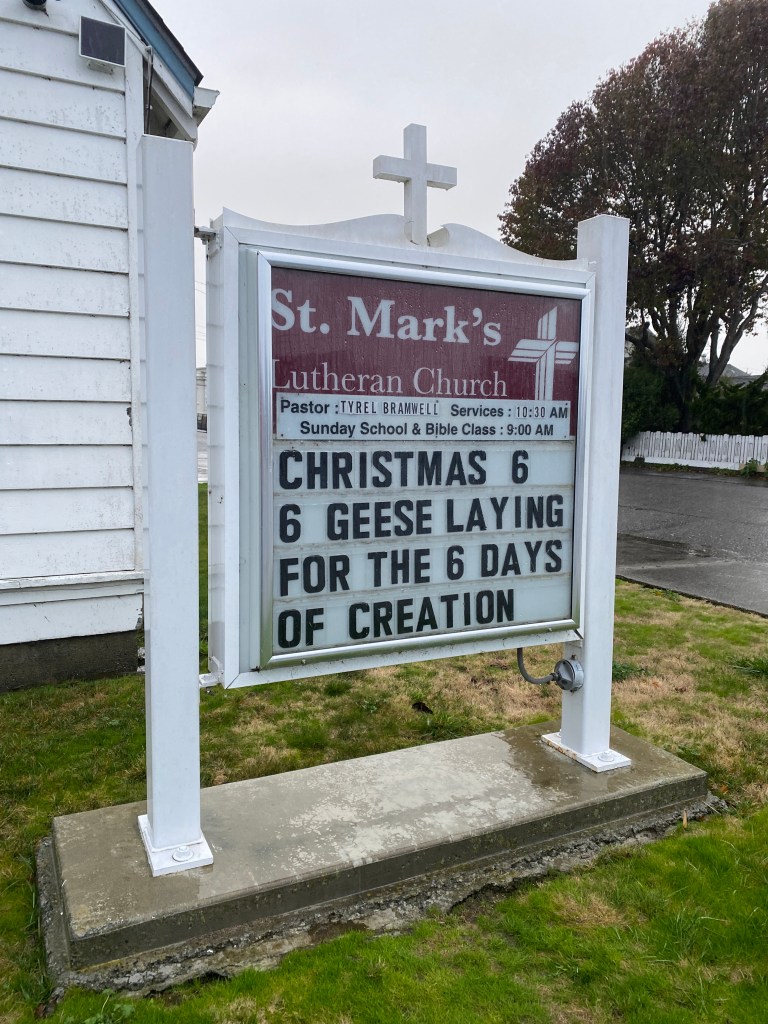
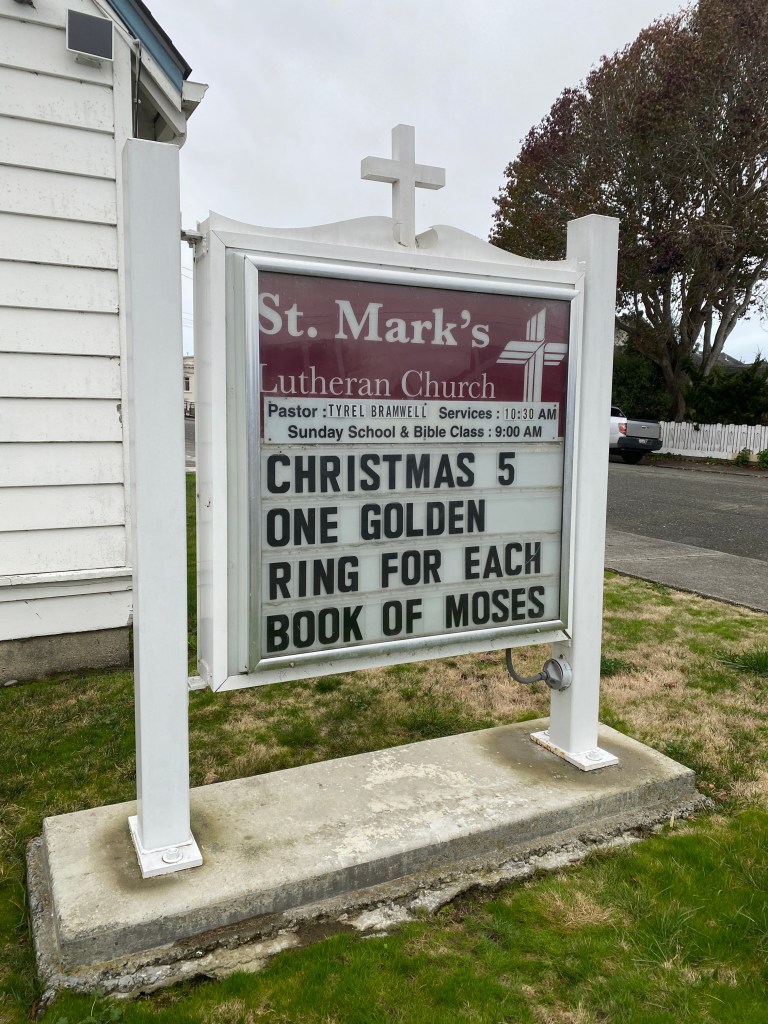
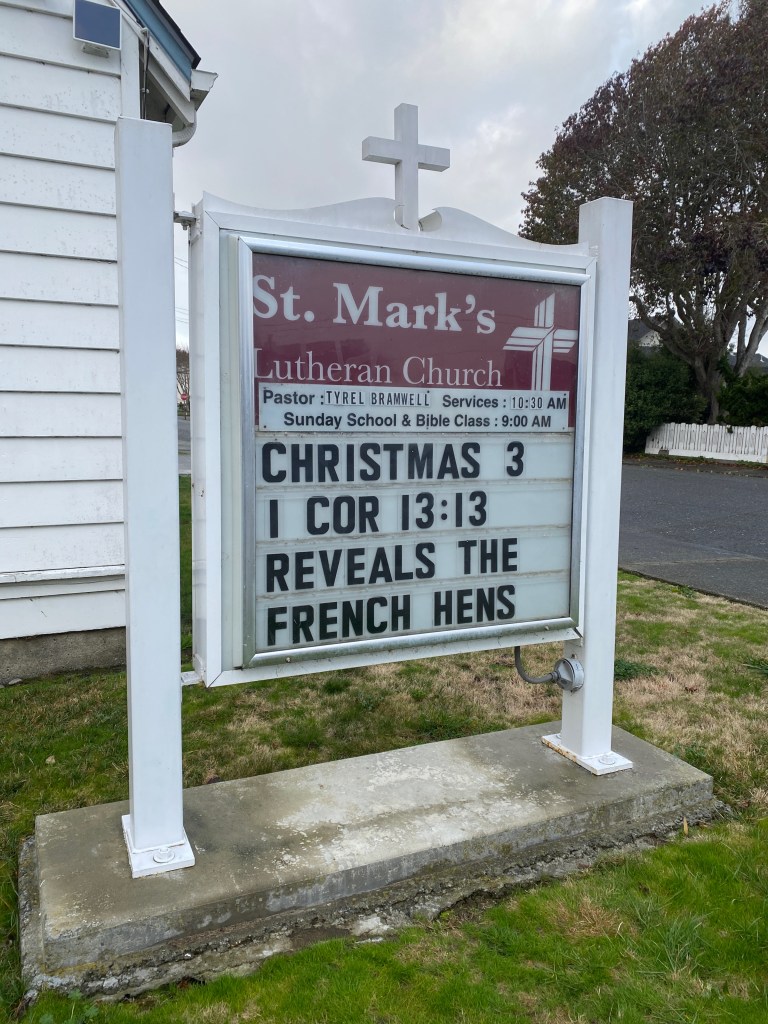
That’s what I want us to take away from this little church sign exercise. The world delivers Christmas to us in a lump known as the “Holiday Season.” According to our contemporary culture, Christmas is one day among a number of holidays. We’re taught to look forward to it primarily from Black Friday to Christmas Eve. Because of this, many people assume the twelve days of Christmas come before Christmas. They don’t. To make matters worse, some marketing schemes riff on the “Twelve Days of Christmas,” running ad campaigns that highlight their sales and services during the “Twelve Days to Christmas.” Confusion abounds!
The Christmas season goes from The Nativity of Our Lord on 12/25 (Christmas Day) to January 5. The Epiphany season begins on January 6. This year, we’ll use the church sign and the classic 18th-century carol to highlight that there are indeed twelve days of Christmas. The symbolism in the song is blessing upon blessing.
Day 1
The Nativity of our Lord
On the first day of Christmas, my true love sent to me a partridge in a pear tree.
Day 2
December 26
On the second day of Christmas, my true love sent to me two turtledoves
The Ferndale Fortitude (Vol. 2 No. 7, December 18, 2022)
John Newton lived from 1725 to 1807. He wrote How Sweet the Name of Jesus Sounds but is, perhaps, best remembered for writing Amazing Grace. He said, “Yet, though I am not what I ought to be, nor what I wish to be, nor what I hope to be, I can truly say, I am not what I once was.”
What was he? In his own words, “a slave to sin and Satan.” Newton knew Satan’s strength. He also knew how deep his sins cut and had firsthand knowledge of slavery. He was a slave trader.
Do you believe there is forgiveness for wretched people? Do you believe a slave trader can become an abolitionist? While most people appreciate second chances for themselves, many today will not entertain grace for others. We live among a population that delights in putting people into pigeonholes. Once a slave trader, always a slave trader. No room for grace. No room for remorse or redemption. We live in a culture that demands reparations while dismissing repentance.
And that is a sad and inconsistent worldview because we all value grace, mercy, and the second chance offered in forgiveness. The other guy may not deserve it, but we certainly appreciate it when it is offered to us.
At St. Mark Lutheran Church, we cling to forgiveness and know full well that God changes people. Their hearts. Their lives. Their souls. Their words and actions. Everything! We live in the grace of Jesus Christ. We repent of sin. And we wholeheartedly denounce the heart-hardening demand of tit-for-tat reparations because Christ already paid our reparations. Each of us has a personal Savior in Christ, who, being the God of justice, recognizes that sins cannot go unanswered. There must be justice. This is why He was born—to be beaten and killed for our evils. Justice for our sins demanded the severest form of reparations. Death.
At St. Mark, we thank God for paying that penalty to repair our relationship, and we praise Him for changing our hearts. We are a congregation of sinners, people just like John Newton, people just like you. We are people who know sin and Satan too well, and by the grace of God, we know that we are no longer slaves to either. As Newton said, we know we are not yet what we ought to be, we are not even what we wish to be, nor what we hope to be. At the same time, we are not what we used to be (Ephesians 5:8).
We’ve included the words to How Sweet the Name of Jesus Sounds. If His name sounds sweet to you—if a real, historic person dealing with your real, historic sins soothes your sorrows—then you are not alone. If, like us, you know you are not what you ought to be, nor what you hope to be, and you find peace in the prospect of God’s justice enabling you to one day look back with a heart that says, “I can truly say, I am not what I once was,” then know that Christ Jesus does make the wounded spirit whole. He truly calms the heart’s unrest. We’ve all experienced it firsthand. You can, too.
As fellow sinners who have been where you are, we are here to help. May you truly have a Merry Christmas in Christ.
This is the video version of Pastor Bramwell’s December 2022 letter to St. Mark.
If the divinity of Christ terrifies you, if His majesty crushes you, then think on His humanity. Consider that God Almighty came to you as an infant. He loves you. At His Nativity, we see that Jesus came to comfort and confirm the repentant conscience.
Subscribe and we’ll email you when we post new content!
Listen every Saturday at 9 AM (Pacific) at KFUO.org or on your favorite podcast app.
Graham Hancock’s hit Netflix show, Ancient Apocalypse, has stirred up controversy. It goes against mainstream science and is all about the memory of a global flood preserved in mankind’s ancient structures. Did an advanced pre-flood civilization exist? Did they teach post-flood people groups their technology? What does this have to do with the pyramids and the stars? Excite your theological imaginations and let’s get into the book of Genesis for some answers.




 St. Mark Lutheran Church